Model a sequence, not a frozen picture
A festival’s physical routes can remain unchanged while their function changes repeatedly. The path used for arrivals may later carry opposing trips to food concessions and toilets. After the final performance, the same path may feed a transport queue outside the boundary. A useful movement study therefore connects a network to a timetable, operational states and assumptions about attendee choices.
Divide the day into meaningful phases without assuming the boundaries are neat. Early arrivals can overlap with staff movements, while one stage’s departure coincides with another stage’s build-up. Record these overlaps explicitly. If the model treats each phase independently, explain what it omits about people remaining on site or queues carrying over into the next phase.
AI-assisted systems may help organise observations, identify recurring timing patterns or compare route-choice assumptions. Their role is to support examination. A confident explanation generated by a language model is not evidence that attendees will behave in that way, and an animated path does not demonstrate that the receiving area can accommodate the movement.
Arrivals begin outside the entrance
Start with how people reach the area. Rail services, shuttle buses, parking releases and walking routes can create pulses rather than a smooth stream. Ticket communications and opening times may influence when people choose to arrive. Use available observations and transport information to construct a plausible range, and record where a previous event is not comparable to the current one.
At the entrance, examine the sequence of decisions and checks. A person looking for the correct ticket lane may pause before reaching the processing point. A bag-search exception may occupy a different space from the main queue. Accessible entry needs clear information and a suitable connection to the rest of the site, not merely a label on the plan.
Review what happens when the intended queue footprint is approached or another interface changes. Who sees the developing issue, who speaks to the relevant partner and which approved options are actually available? Do not assume that opening a gate, redirecting a queue or changing a traffic arrangement is an immediate or authorised action.
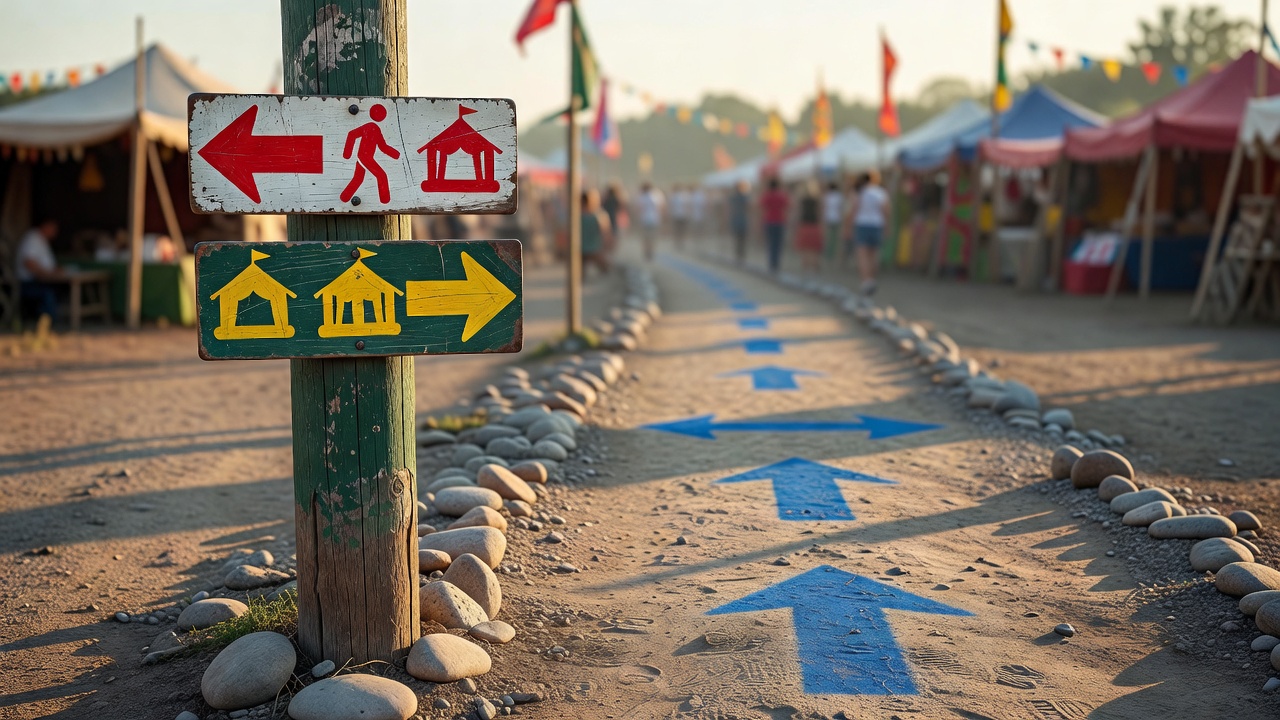
Changeovers redistribute people unevenly
Programme timing can create linked movements between stages, amenities and rest areas. Avoid assuming that everyone leaving one performance travels directly to the next. Some remain in place, some meet friends and others stop at a queue. Those choices affect where demand appears and how long it remains. Test alternative distributions when reliable evidence is unavailable.
Crossings deserve particular attention because several ordinary journeys can compete for the same space. A food queue can extend across a desire line; a popular viewing position can narrow a route without any formal closure. Examine local accumulation and hesitation rather than only counting completed trips. Staff visibility and the ability to communicate with people also matter.
Weather and ground conditions can redistribute movement. People may avoid an exposed route, gather under cover or move around a damaged surface. A model built on shortest paths alone may miss these preferences. Treat route choice as an assumption to challenge and compare, particularly where one apparently minor preference changes the conclusion.
Departures continue beyond the boundary
A site exit is an interface, not an endpoint. Review the walking route, onward queue, crossing and transport pickup beyond it. If the receiving system has limited service or changes during the evening, the departure pattern may be shaped by that constraint. Coordination with the relevant transport operator and landowner is therefore part of the planning evidence.
Consider staggered departures as well as a concentrated finish. Programme changes, weather or travel information can alter when people leave. Check lighting, accessible pickup arrangements and how people obtain reliable information after leaving a performance area. A route that is legible in daylight may be harder to interpret after dark or when temporary signs are obscured.
Keep routine departure analysis separate from emergency planning while recognising shared dependencies. An emergency may remove a route, change behaviour or require coordination that is absent from the routine case. A successful routine simulation does not validate an evacuation plan. Emergency arrangements require their own competent development and review.
Turn phase assumptions into observations
For each important assumption, identify a feasible observation. Arrival timing might be checked through aggregate entry records; a route-choice concern might require an appropriately positioned observer. Record coverage gaps and reporting delays. The absence of a report is not proof that a location is operating as expected, especially where visibility is limited.
Use established event-management guidance to frame the review. The HSE event safety resources, Purple Guide and UK crowded places guidance address related planning contexts. Security guidance from the National Protective Security Authority concerns additional risks and should not be mistaken for a complete crowd-flow assessment. Applicable local requirements remain decisive.
The final output should describe the sequence, evidence, uncertainty and operational owner for each material interface. That is more useful to a review meeting than a single route image presented without its timing assumptions.